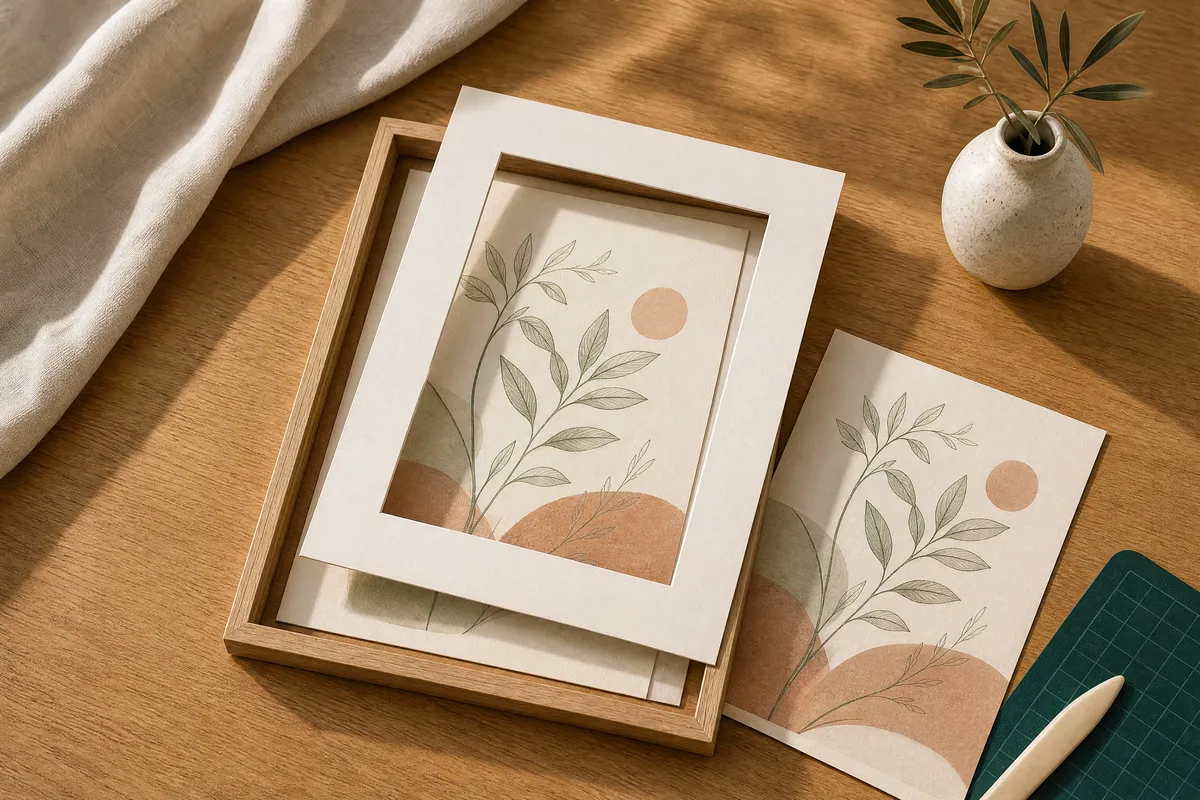
The clearest example is the most popular frame in the range. A 30 x 40 cm frame has a 21 x 30 cm artwork window once its mount is in. That is A4 territory, not A3.
So the practical rule is the opposite of what most people do. Do not download a file the size of the window. Download a file the size of the opening, and let the mount cover the edges. A print that is slightly too big disappears neatly under the mount. A print that is slightly too small shows a strip of backing board, and there is no fixing it once it is behind glass.
The rest of this guide is the full ladder, in centimetres.
The ladder, straight from IKEA
IKEA publishes both numbers itself, side by side, on its picture frame guide. The middle column is the one nobody reads.
| Frame is sold as | Artwork window with the mount | IKEA’s paper-size note |
|---|---|---|
| 10 x 15 cm | 8 x 12 cm | close to A7 |
| 13 x 18 cm | 10 x 15 cm | A6 |
| 21 x 30 cm | 13 x 18 cm | close to A5 |
| 30 x 40 cm | 21 x 30 cm | A4 |
| 40 x 50 cm | 30 x 40 cm | A3 |
| 50 x 70 cm | 40 x 50 cm | close to A2 |
| 61 x 91 cm | 50 x 70 cm | A1 |
Read down that middle column and you will notice something tidy: every frame’s window is the next size down in the same range. The 40 x 50 frame shows you exactly what a 30 x 40 frame is called. The 50 x 70 shows you a 40 x 50. The whole ladder is shifted by one rung.
That is why a gallery wall bought in one trip so often looks off. People choose frames by the outside number, assume the pictures will be proportionally spaced, and then find that the visible artwork in each one has quietly shrunk by a step.
The bit IKEA says out loud, and the bit it does not
The company is direct about what the label means: “IKEA frame sizes refer to the inner dimensions, the space where your image or mount fits. The external frame dimensions are slightly larger and vary by design.”
So the number is the opening, not the outside of the frame and not the visible picture. It sits in between, which is the least intuitive of the three options.
It is also not true that every frame arrives with a mount: “Not all frames come with a mount. RODALM, for example, often includes one, while others like FISKBO do not. Mount details are listed in each product’s specifications.”
This matters more than it sounds. A 30 x 40 cm frame without a mount takes a 30 x 40 cm print. The same frame with its mount shows 21 x 30 cm. Same box, same label, two different answers, and the only way to know which one you are holding is the product specification.
Buy the mount version and print at 30 x 40 anyway. The mount will overlap about 4.5 cm on each long edge and 5 cm top and bottom, and it will look deliberate. That overlap is what a mount is for.
Where the paper sizes really line up, and where they do not
IKEA’s FAQ says some sizes match standard paper and some do not: “Some do, like 21x30 cm (A4) and 50x70 cm (A2 approx), but others (like 30x40 cm or 40x50 cm) are unique to IKEA.”
Worth checking that against the A-series, which the same page prints:
| Paper | Size |
|---|---|
| A6 | 10.5 x 14.8 cm |
| A5 | 14.8 x 21 cm |
| A4 | 21 x 29.7 cm |
| A3 | 29.7 x 42 cm |
| A2 | 42 x 59.4 cm |
| A1 | 59.4 x 84.1 cm |
Two things fall out of putting those next to each other.
A4 is 0.3 cm short. An A4 sheet is 21 x 29.7 cm. The window in a 30 x 40 frame is 21 x 30 cm. So an A4 print, centred, leaves 0.15 cm of backing board peeking out at the top and bottom edge. Under glass, at arm’s length, on a light print, you will probably never see it. On a dark or full-bleed print against a white board, you will see it every time you walk past. This is the single most common reason a downloaded print looks slightly wrong in a frame that is technically the right size.
“A2 approx” is doing some work. A2 is 42 x 59.4 cm. A 50 x 70 cm frame is 8 cm wider and 10.6 cm taller than that. If you drop an A2 sheet into a 50 x 70 frame with no mount, you get a 4 cm gap down each side and a 5.3 cm gap top and bottom. That is not a near miss, it is a visible border of empty board. With the mount in, the window is 40 x 50 cm, and now the A2 sheet is bigger than the window in both directions, so it sits behind and the mount trims it — 1 cm off each side and 4.7 cm off the top and bottom of your image. That version looks fine. The unmounted version does not.
The useful generalisation: oversize is recoverable, undersize is not. A print larger than the window loses its edges to the mount. A print smaller than the window shows board, and the only fix is to reprint or to have a mount custom cut.
IKEA’s own advice lands in the same place: “What if my artwork doesn’t match any IKEA size exactly? Choose a slightly larger frame and use a custom-cut mount for a professional finish.”
Which file to download, by frame
Assuming the mount is in and you want the picture to fill the window with a clean overlap:
| You bought | Download this | Why |
|---|---|---|
| 30 x 40 cm | 30 x 40 cm, or A3 at 29.7 x 42 cm | Fills the 21 x 30 window with generous overlap. A4 will fit but sits 0.3 cm short on the long edge. |
| 40 x 50 cm | 40 x 50 cm | Window is 30 x 40 cm; the sheet overlaps 5 cm each side. |
| 50 x 70 cm | 50 x 70 cm | Window is 40 x 50 cm. A2 also works behind the mount; it does not work without one. |
| 21 x 30 cm | 21 x 30 cm, or A4 | Window is 13 x 18 cm; both overlap comfortably. |
| 61 x 91 cm | 61 x 91 cm | Window is 50 x 70 cm. This is the poster size, and the ratio is unusual — do not substitute A1. |
If a shop only offers ratios rather than sizes, the two that cover most of this table are 3:4 and 2:3. A 30 x 40 cm print is exactly 3:4. A 50 x 70 cm print is close to 5:7, which is why 2:3 files always need a small trim to sit in one.
The same problem in inches, for anyone buying from a US shop
If your frame came from a US framer, none of the numbers above apply, because the whole system is built on a different set. Framebridge publishes its standard sizes in inches only, so here they are converted at 2.54 cm to the inch, with the arithmetic shown:
| Framebridge art size | Converted |
|---|---|
| 5 x 7 in | 5 x 2.54 = 12.7 cm, 7 x 2.54 = 17.78 cm, so 12.7 x 17.78 cm |
| 8 x 10 in | 20.32 x 25.4 cm |
| 11 x 14 in | 27.94 x 35.56 cm |
| 16 x 20 in | 40.64 x 50.8 cm |
| 24 x 36 in | 60.96 x 91.44 cm |
Notice that none of those is an A-size and none of them is an IKEA size. 40.64 x 50.8 cm is close enough to 40 x 50 cm to be tempting and far enough away to leave a 0.64 cm strip of board on one edge and 0.8 cm on the other. 60.96 x 91.44 cm sits within half a centimetre of IKEA’s 61 x 91 cm, which is the one genuine near-equivalence in the whole comparison.
That page is a standing reference from 2021 rather than a current price list, so treat the sizes as the useful part and check anything else on the day.
The five-minute version
- Turn the frame over, or open the product page, and find out whether it ships with a mount.
- If it does, the picture you will see is one rung smaller than the number on the box.
- Download at the frame’s stated size, not the window size. Overlap is invisible, gaps are not.
- For a 30 x 40 cm frame with a mount, A4 fits but runs 0.3 cm short on the long edge. A 30 x 40 file does not.
- If a file only comes in a ratio, 3:4 covers 30 x 40 and 2:3 needs trimming for almost everything in the IKEA range.
For the related trap on the paper side rather than the frame side, see our guide on A4 versus Letter, which is why a file that fits your frame can still refuse to fit your printer.
Pin this guide
The frame is named after the opening. The mount is what you actually see. Save the ladder.
Pin 1 of 2 — save to Pinterest 
Pin 2 of 2 — save to Pinterest