
The rate and the dates come from the proclamation, read here by Wiley Rein’s alert on the new tariffs: “On July 20, 2026, President Trump invoked Section 338 of the Tariff Act of 1930 (‘Section 338’) to impose 50% additional tariffs on certain goods of Canada, including United States-Mexico-Canada Agreement (USMCA)-compliant goods, effective August 19, 2026.”
The word doing the most work in that sentence is certain. This is a covered-goods list, not a blanket. Nothing in it supports “Canadian art costs 50% more now,” and this guide is not going to say it.
What follows is what the list actually names, how to find out where a frame was made before you pay for it, and what the alternatives look like in centimetres.
Two dates, and the weekend in between
The legal effective date is Wednesday 19 August 2026, per the same alert. The wire coverage came later: the Associated Press wrote the story up on Monday 24 August under the line that the tariffs just went into effect, reporting that Canadian Prime Minister Mark Carney “quickly promised Saturday that his government would roll out ‘dollar for dollar’ retaliatory measures starting Sept. 8.”
Between those two dates is the part you would actually have noticed. Listings started changing over the weekend of 22 and 23 August, which is when sellers began comparing notes in public.
The scale, for context rather than alarm. AP puts the affected trade at “about 5% of Canada’s annual exports to the U.S., roughly $20 billion in goods,” and notes that Canada sent 72% of its goods exports to the US last year. Wiley Rein’s alert gives the same order of magnitude from the US Trade Representative’s side: “nearly $20 billion in annual imports of goods from Canada.”
A large number attached to a narrow slice. Most of what is on your wall is not in it.
What the list names, in its own words
Two entries on the covered-goods list matter for a gallery wall, and they are separate entries — the frame and the thing inside it are counted independently.
| Covered category | The list’s own wording |
|---|---|
| Wood products | ”Certain wood products, including wood moldings, particle board, MDF, plywood and veneered panels, doors, picture frames, and pulpwood” |
| Art and collectables | ”Certain art, antiques, and collectors’ items” |
Both quotations are from Wiley Rein’s reading of the covered-goods list.
Three things follow from reading that carefully rather than quickly.
Picture frames are named as a manufactured wood product, not as decor. They sit in the same entry as mouldings, MDF and plywood, which is a hint about how the category is drawn. A frame is lengths of milled moulding and a backing board, and that is the part being described.
“Certain art” is not “all art”. The list does not publish a plain-English definition of which pieces qualify, and this guide is not going to invent one.
Whether a reproduction print is treated like an original is genuinely unresolved. One Canadian seller, describing her own paperwork, says both her originals and her fine-art prints moved. That is one seller’s customs experience, not a published ruling, and nothing consulted for this piece settles it either way. If it matters to your purchase, it is a question for the seller and their broker, not for a blog.
What sellers are visibly doing about it
The clearest picture of the practical effect is not in a press release. It is in a thread of Canadian Etsy sellers of original art and fine-art prints comparing notes: “How are my fellow Canadian sellers handling the new 50% tariffs?”, 76 comments and 46 upvotes at 88% upvoted, with the comments starting on 23 August.
Three responses come up repeatedly in that thread: switching off shipping to the US entirely, setting US-specific prices, and folding the cost into a shipping line rather than the item price.
That is community reaction, not marketplace policy, and it is worth being precise about what it does and does not tell you. It tells you that a listing you saw a fortnight ago may not price the same way today, and that two shops selling comparable work may have chosen opposite tactics. It does not tell you that any given order costs a fixed percentage more. Nobody has published that number, sellers are doing three different things, and any buyer-side total you see quoted is somebody’s arithmetic rather than a source.
Etsy keeps its own running announcement thread on tariff policy — the marketplace’s tariff-guidance topic, whose title read “UPDATED AUG 24” when it was checked on 25 August. The body sits behind a login, so nothing from inside it is quoted here.
How to check where a frame was made, before you buy
The list is about where a good comes from, not who sells it. A Canadian shop can sell you a frame milled in Poland. A US shop can sell you one made in Ontario. Country of origin and shipping address are different facts, and only one of them is on the list.
In order of how much work it takes:
- Read the listing’s own origin field. If a shop publishes where an item is made, that is the fastest answer you will get.
- Ask. A message before you buy costs nothing and takes a day. “Where is this frame manufactured?” is a normal question, and a shop that frames its own work will answer it immediately.
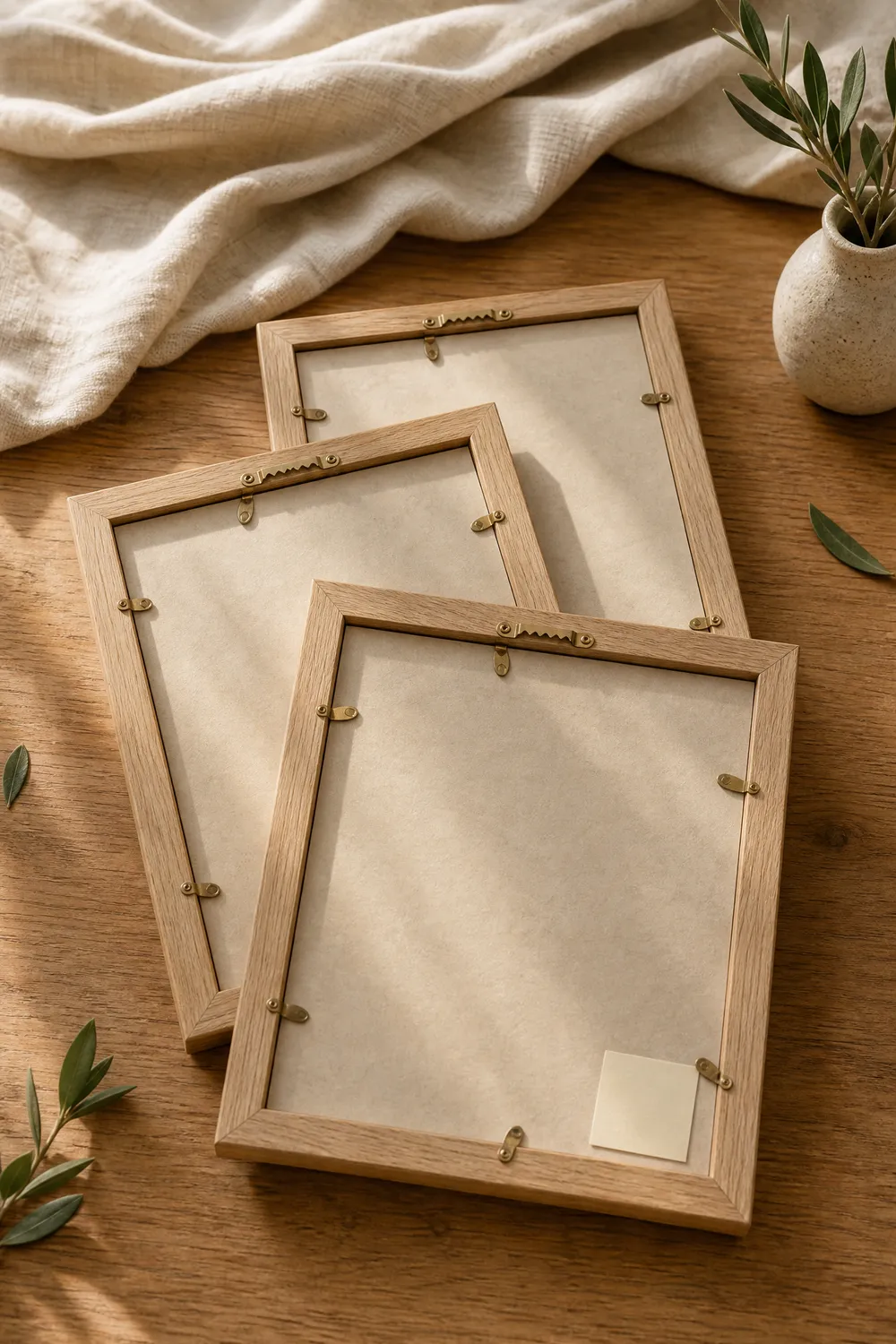
- Turn the frame over, if you can hold it. Origin is commonly printed on the backboard or on a sticker at one corner, next to the hanging hardware. If there is nothing there at all, that is itself information — ask before you commit.
- Separate the moulding from the assembly. Custom framers buy moulding by the length and cut it to size. If you are ordering made to measure, the moulding’s origin is the thing to ask about, not the workshop’s address.
One thing not to over-read: a warehouse in Ohio can hold stock made anywhere. Shipping from inside the US does not answer the question.
The alternatives, in centimetres
Reframe rather than rebuy. The cheapest frame in any of this is the one already hanging on your wall. Swapping the print inside a frame you own has no origin, no border and no tariff line, because nothing moves. Our guide on what actually fits your frame maps the standard ladder — 21 x 30, 30 x 40, 40 x 50, 50 x 70 and 61 x 91 cm — and, more usefully, what is still visible once the mount goes on top.
Widen the mount instead of buying a bigger frame. A 30 x 40 cm frame with a generous mount reads as a larger and more deliberate piece than the same frame filled edge to edge. Mount board is the cheapest square centimetre in framing. That is a styling opinion rather than a sourced fact, but it is the lever most people forget they have.
If you are shopping in the US, the ready-made range just got wider. Michaels announced on 18 August 2026 that it is rebuilding its framing offer across North America: over 200 new ready-made frame styles, a five-moulding curated collection made with Architectural Digest, and an online frame builder that projects a design onto your own wall through a phone scan. The same announcement adds same-day custom canvas prints starting at $20, in two sizes: 20.32 x 20.32 cm and 20.32 x 25.4 cm. The release gives those as 8 x 8 in and 8 x 10 in; the conversion is 1 in = 2.54 cm, and that is the only place inches appear in this guide.
Worth noticing what those two numbers are not. 20.32 x 25.4 cm is not 21 x 30 cm, and it is not A4 at 21 x 29.7 cm either. It is 0.68 cm narrower and 4.6 cm shorter than a 21 x 30 frame, so a file built for the European ladder will not drop into it, and the reverse is just as true. That is a separate problem from the tariff, and it is the one covered in A4 versus Letter.
If you are not importing into the US, this is not your news. It is a US import tariff. Your 40 x 50 cm frame from a European shop is exactly as expensive as it was on 18 August. The one thing worth watching from outside is the retaliation date Carney named for 8 September in the AP report above, which is a different list entirely and not one this guide has read.
And the single sentence of self-interest, since a printables site owes you the disclosure rather than the sales pitch: a downloaded file is not a good crossing a border, so a covered-goods list does not describe it. The frame you hang it in is still a physical object that came from somewhere, which is the whole reason this guide is about frames.
The five-minute version
- The change is a 50% additional US tariff on a named list of Canadian goods, effective 19 August 2026. Frames and certain art are both on it, as separate entries.
- “Certain” is load-bearing in both entries. Do not read the list as covering everything Canadian, and do not read it as covering nothing.
- Origin is the question, not the seller’s address. Read the listing, ask the shop, or turn the frame over.
- Nobody has published a buyer-side percentage, because sellers are absorbing it, repricing, or moving it into shipping — three different answers to the same problem.
- The cheapest response involves no purchase at all: keep the frame, change the print, and check the mount before you check the price.
Pin this guide
Frames and art are named separately on the list. Where it was made is the only question that matters. Save the checklist.
Pin 1 of 2 — save to Pinterest 
Pin 2 of 2 — save to Pinterest