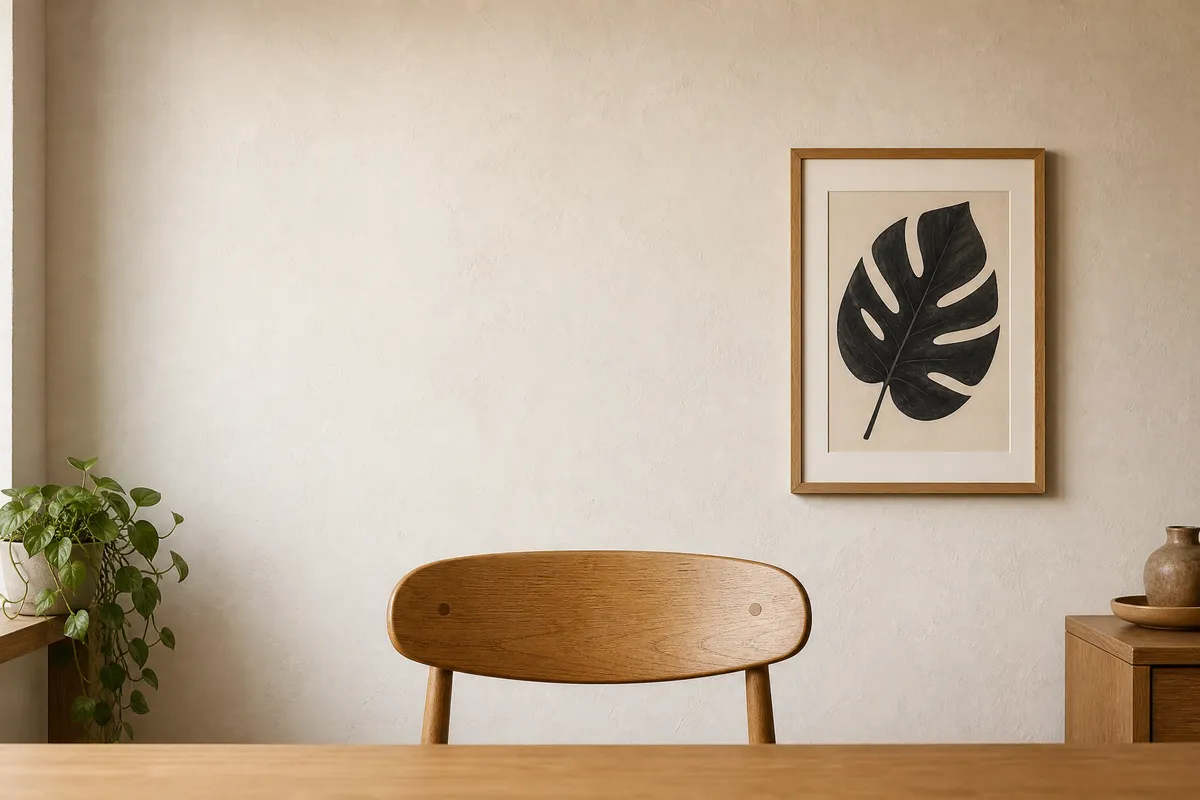
A common webcam sitting about 1.2 m from the wall behind you shows roughly 169 cm of wall width and 95 cm of height. That is a much smaller stage than the wall you are actually looking at, which is why a carefully arranged gallery wall so often turns into two half-cropped frames and a light switch on screen.
Hang one piece, size it to the visible area, keep it off your head, and let the wall be quiet. The rest of this guide is the measurements.
Your camera sees a rectangle, not a room
Most fixed webcams state a diagonal field of view. Logitech’s C920s, one of the most widely used, is specified with a “diagonal, fixed 78° field of view” on Logitech’s own product page.
Diagonal is not the number you need. What you need is how wide a slice of wall that becomes at the distance you actually sit. For a standard 16:9 video frame, a 78° diagonal works out to about 70° across and 43° top to bottom, and that gives you this:
| Distance from camera to wall | Visible wall width | Visible wall height |
|---|---|---|
| 0.8 m | 113 cm | 64 cm |
| 1.0 m | 141 cm | 79 cm |
| 1.2 m | 169 cm | 95 cm |
| 1.5 m | 212 cm | 119 cm |
| 2.0 m | 282 cm | 159 cm |
| 2.5 m | 353 cm | 199 cm |
Two honest caveats before you use that table. It assumes a 16:9 frame with no digital cropping, and many laptops and conferencing apps crop in or auto-frame you, which makes the visible area smaller than the numbers above, never larger. And it assumes the wall runs parallel to the camera. If you sit at an angle to the wall, the visible band is wider but foreshortened, and art on it will read as a trapezoid.
Measure your own distance before you trust the row. A tape measure from the camera lens to the wall takes ten seconds and is the single most useful thing in this guide.
You are standing in front of most of it
Now subtract yourself.
Seated at a desk, your head and shoulders occupy roughly the middle 40 to 50 cm of that frame, and rather more of the lower half. At 1.2 m, that leaves two usable panels of wall of about 55 to 65 cm each, on either side of your head, plus a band above you.
This is the thing that quietly ruins most video-call walls. The centre of the wall — the place anyone would naturally hang a single picture — is the one part of it that is permanently blocked. A print hung dead centre behind a seated person is a print nobody will ever see.
What actually fits
Working from the ISO A-series sizes, and remembering that a frame is larger than the print inside it:
- A3, 29.7 x 42.0 cm. Framed, roughly 40 x 50 cm. This is the reliable choice. At 1.2 m it fills a usable side panel without crowding it, and it stays legible at the small size a video tile is actually displayed.
- A2, 42.0 x 59.4 cm. Framed, roughly 50 x 70 cm. Good at 1.5 m and beyond, hung to one side. At 1.0 m it will be clipped by the frame edge.
- A4, 21.0 x 29.7 cm. Framed, roughly 30 x 40 cm. Too small on its own. It reads as a sticky note on screen. Use a pair, stacked, if you like this size.
If you want the full metric size table and the printing detail behind it, our complete guide to sizing, printing, framing and hanging has it, and the A4 versus Letter guide covers what happens when the file and the paper disagree.
Hang it higher than feels right
The standard gallery height puts a picture’s centre at about 145 to 150 cm from the floor, which is eye level for a standing adult.
A video call is not a standing adult. The camera is at roughly seated eye level, usually 100 to 120 cm from the floor, and it is looking slightly up or straight ahead. Art hung at standing-gallery height often lands in the top strip of the frame or disappears above it entirely.
For a wall that exists mainly for calls, drop the centre of the piece to roughly 125 to 135 cm from the floor, and offset it so it sits over your shoulder rather than your head. Then join a call, look at your own preview, and adjust. Your preview window is the only ground truth here, and it takes one call to get it right.
Do not let a frame edge cut through your head. A horizontal frame line crossing your temple is the single most distracting thing you can put on that wall.
Choose the print for a small, compressed rectangle
Whatever you hang is going to be viewed at a few centimetres across, through compression, in a grid of other faces. That rules out more than people expect.
What survives: high contrast, few elements, one clear shape. A single bold botanical. An architectural line drawing. A large-format abstract with two or three colours. A black and white photograph with a strong subject.
What does not: fine detail, thin type, busy patterns, anything with small text. Delicate line work dissolves into grey mush at video-tile size. A print with a quote on it becomes an unreadable smudge that people will squint at instead of listening to you.
Colour is worth a thought too. A very light print against a light wall vanishes; a very dark one against a dark wall becomes a hole. You want mid-contrast against your wall, not maximum contrast.
Two prints, or one?
One, in most rooms.
A pair works if you have the width — at 1.5 m or more you have roughly 212 cm to play with, and two matching frames flanking you at equal height reads as deliberate rather than accidental. Keep them identical in size and frame, and keep the gap consistent with the 5 to 8 cm spacing that makes a group read as one object.
A full gallery wall behind a desk almost never works on camera. There is not enough visible width for the arrangement to make sense, so the viewer sees fragments of frames and reads it as clutter. Save the gallery wall for a wall people see in person.
The five-minute version
Measure camera to wall. Find your row in the table. Subtract about 50 cm in the middle for yourself. Hang one A3 or A2, framed, centred around 125 to 135 cm from the floor and offset over one shoulder. Join a call and look at your own preview.
Then leave it alone. The best video-call wall is the one nobody comments on, because it looks like a room you happen to work in rather than a set you built.
Pin this guide
A webcam at 1.2 m sees about 169 cm of wall. Hang one A3 over your shoulder, not behind your head.
Pin 1 of 2 — save to Pinterest 
Pin 2 of 2 — save to Pinterest