
The complication is that they do not all agree. Six independent sources were read for this guide, all of them describing the same museum convention, and between them they give six different heights: 57, 60, 62, 63, 65 and 66 inches. One page gives three of those numbers on its own.
And with a single exception, none of them ever tells you what that is in centimetres. Five of the six contain no centimetre figure anywhere on the page. If you measure in cm, which is most of the world, every one of these pages hands you an arithmetic problem and walks away.
So here is the arithmetic, done once, for all of it.
The rule everyone quotes
Apartment Therapy’s version, updated 30 March 2023 and written by the site’s founder Maxwell Ryan, is the one most others trace back to:
hang anything you like, any size you like, but hang it at 57″ on center
The same piece explains why that number: “the 57″ standard represents the average human eye-height and is regularly used as a standard in many galleries and museums.”
Two things are worth holding onto. “On center” means the middle of the picture, not the top and not the bottom, which is where most people go wrong before they ever get to the unit. And the justification is average eye height, which is a population average, not a fact about your wall.
57 inches is 144.8 cm.
The same rule, six different numbers
Every figure below was read from the page itself. Conversions are ours, at exactly 2.54 cm to the inch, rounded to one decimal place.
| Source | Date on page | Centre height as published | In centimetres |
|---|---|---|---|
| Apartment Therapy | 30 Mar 2023 | 57 in | 144.8 cm |
| Framebridge | 5 Oct 2023 | 57 in, and 60 to 66 in in a hallway | 144.8 cm, and 152.4 to 167.6 cm |
| Fab Art | 27 Jul 2025 | 57 in, with eye level given as 57 to 65 in | 144.8 cm, 144.8 to 165.1 cm |
| Picture Hanging Systems | none shown | 60 to 63 in, 62 in, and 57 in | 152.4 to 160.0 cm, 157.5 cm, 144.8 cm |
| AS Hanging | none shown | 57 in, stated by the source as 145 cm | 144.8 cm |
| The Frame Room | none shown | 57 to 60 in, and 60 to 65 in under a high ceiling | 144.8 to 152.4 cm, 152.4 to 165.1 cm |
The spread from lowest to highest is 57 to 66 inches, which is 144.8 cm to 167.6 cm. That is nearly 23 cm of disagreement about a rule everyone describes as settled.
The page that disagrees with itself
Picture Hanging Systems is the clearest illustration, because all three of its numbers sit on one page.
Near the top:
A simple rule of thumb to hanging art at the right height is to place the center of the art object at 60″ to 63″ above the floor.
Further down:
The ideal height to hang artwork is so that the center of the piece is at eye level. This is usually around 62 inches from the floor.
And further down again:
For most pictures, hang them so that the center of the picture is at eye level, which is usually around 57 inches from the floor.
152.4 to 160.0 cm, then 157.5 cm, then 144.8 cm. Three answers, one page, all of them offered as the eye-level standard. The lowest and the highest are 15.2 cm apart, which on a wall is the difference between a picture that reads as hung and one that reads as slightly too high.
This is not an argument that the page is bad. It is an argument that “eye level” is doing a lot of unexamined work across this whole genre, and that the moment you ask for one number, you get several.
The only source that converts
Of the six, exactly one prints a centimetre figure. It is AS Hanging, a hanging-hardware supplier, not an editorial site:
The rule of 57 is a hanging-height guideline: position the center of your artwork about 57 inches (145 cm) from the floor, which matches average eye level.
145 cm is correct. The exact conversion is 144.78 cm, and 145 is the sensible round for a pencil mark on a wall. Nobody is measuring to the tenth of a millimetre with a spirit level in one hand.
Worth being fair about what the other five are doing. They are US-facing publishers writing for a US-facing audience in the unit that audience uses. The gap is not an error, it is an omission, and it is an omission that gets copied every time the rule is repeated. A reader in Budapest, Berlin or Brisbane inherits a number in a unit their tape measure does not have.
What actually goes on your wall
Three heights cover almost every real room. All of these are centre heights, meaning the vertical middle of the picture or of the arrangement.
| Situation | Height | Where it comes from |
|---|---|---|
| Standard wall, seated or standing view | 145 cm | The 57-inch rule, rounded |
| Hallway, seen standing and up close | 152 to 168 cm | Framebridge’s stated exception |
| Above furniture | bottom edge 17.8 to 25.4 cm above the furniture top | Framebridge, 7 to 10 in |
That last row is the one that overrides everything else. Framebridge’s own guidance is that when a picture hangs over a sofa, a bed or a desk, the gap to the furniture is what your eye judges, and a piece placed at a textbook 145 cm centre can still look wrong if it floats too far above the sofa back. Measure the gap first, then check where the centre landed.
Framebridge is also explicit that a high ceiling does not change the rule: it “suggests the same rule of thumb of 57 inches off the ground for the vertical center.” The Frame Room disagrees and suggests going to 152.4 to 165.1 cm in that case. Both are on the table; the ceiling does not decide, the viewer’s eye does, and if you mostly sit in that room the lower number is the safer bet.
How to mark it, in cm
- Measure the height of the picture, or of the whole arrangement if you are hanging a group, and halve it.
- Mark 145 cm up from the floor. That is your centre.
- Add the half-height from step 1 to 145 cm. That is where the top edge of the frame goes.
- Measure from the top edge of the frame down to the hanging wire or hook when the wire is pulled taut. Subtract that.
- The result is where the nail goes.
Step 4 is the one people skip, and it is the reason so many pictures end up 3 to 5 cm high. A taut wire sits below the frame top, so the hook has to sit below your top-edge mark by exactly that amount.
For a group, treat the whole arrangement as one rectangle and put the centre of that rectangle at 145 cm. The individual pictures inside it can sit wherever the composition wants them.
The honest caveat
145 cm is a convention derived from an average, and averages are not people. If everyone in your household is noticeably taller or shorter than average, or if the room is one you are always seated in, move it. A dining room where you are seated most of the time takes a lower centre comfortably. A hallway you only ever walk through takes a higher one, which is precisely why Framebridge carves out the exception it does.
The point of the number is not that it is correct. It is that it is a defensible starting mark that stops you hanging at 165 cm out of instinct, which is what most people do. Start at 145 cm, look at it, then move it if the room argues.
All six sources were opened and read on 8 September 2026. Every inch figure quoted is the source’s own wording; every centimetre figure is our conversion at 2.54 cm to the inch, except AS Hanging’s 145 cm, which is theirs.
Pin this guide
Save any of these to your Pinterest boards — they link straight back to this guide.
Pin 1 of 2 — save to Pinterest 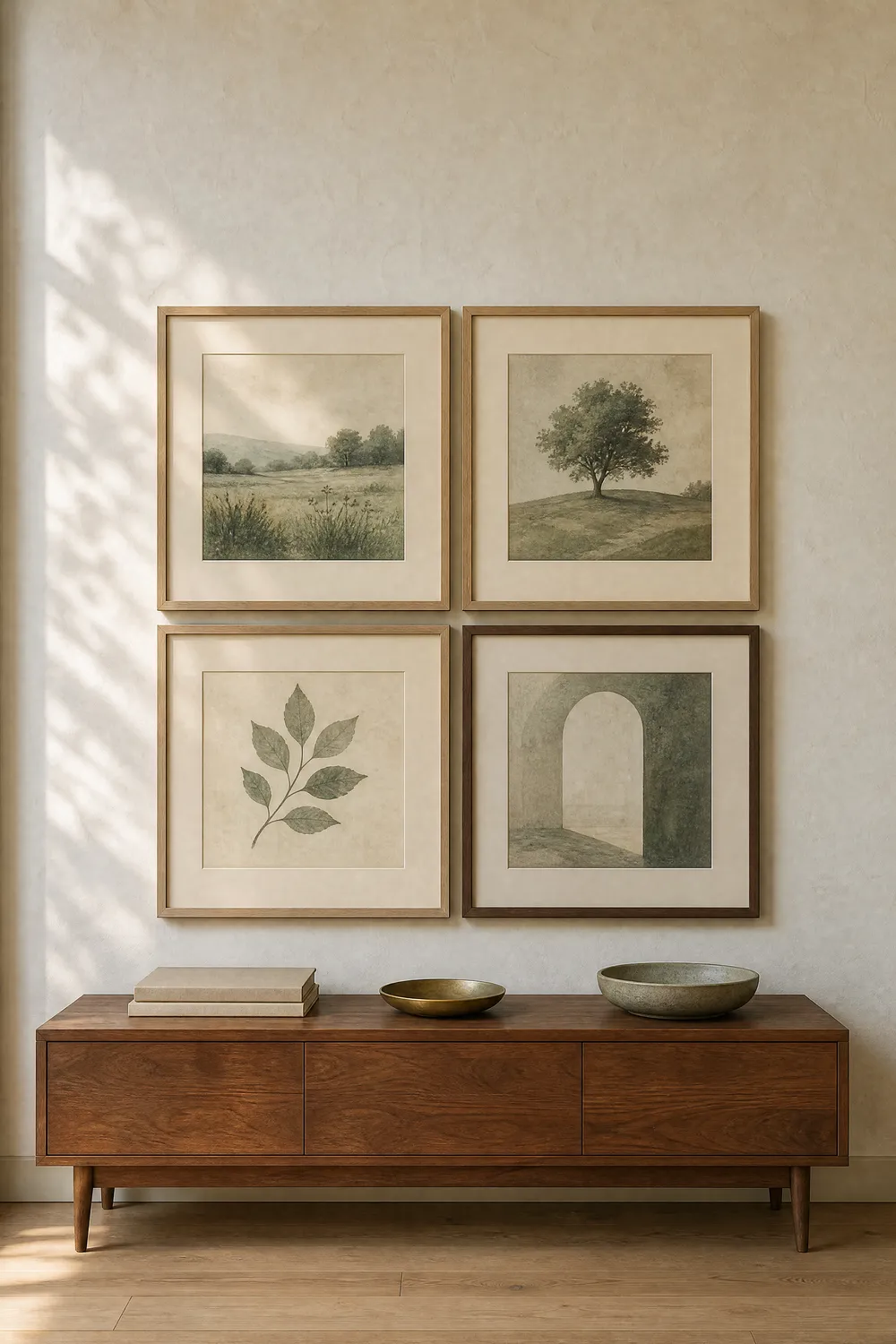
Pin 2 of 2 — save to Pinterest